
Posted May 15th, 2012
Google and Microsoft Research Teams Develop New Video Technologies Tip by Rob Scott
- Researchers at Google have developed a technique called auto-directed video stabilization designed for recording video via smartphones and mobile devices with greater stability and improved image quality.
- The technique mimics how motion is smoothly recorded in professional productions with dollies and tripods.
- "The technology supports an algorithm that automatically determines the best camera path and recasts the video as if it were filmed using stabilization equipment," reports MediaPost. "The research is being integrated into YouTube to support videographers."
- Microsoft Research, meanwhile, is developing motion technology that will enable a mobile device to function as a weapon in a game, such as a sword used to go on the offensive or to block the attacks of other players.
- "Phone-to-phone mobile motion games must have the ability to calculate accurate distance and range from each other. Then range, speed, and accuracy are calculated," explains the post. "The process works similar to Kinect, a fixed infrastructure motion capture system that supports game motion in real-time."
Original Source: www.mediapost.com
Posted May 15th, 2012
Posted: Mon 23 Apr, 2012 Play is a powerful thing. It can change behaviour; transform perceptions of space; reveal histories and futures; provoke meaningful responses to social and environmental challenges; and inspire audiences to participate and contribute, rather than simply observe. Inspired by projects such as HeHe’s Nuage Vert and Rafael Lozano-Hemmer’s Nave Solar, Watershed and the British Council are creating a number of opportunities for artists to create new ideas on the theme of The Playable City. The Playable City Sprint was the first project in this series. It enabled twelve artists from across the UK and East Asia to spend a week in February 2012, developing collaborative ideas within the supportive environment of the Pervasive Media Studio. We’re now pleased to announce our second event, The Playable City Ideas Lab, which will take place this May in Recife, Brazil. The Ideas Lab will run as part of Expoideia, an innovative event focused on culture, technology and sustainability. We’re inviting 60-70 Pernambuco based practitioners from varied disciplines such as art, design, technology and city planning, to spend a lively afternoon collaboratively developing playful, hypothetical interventions that rethink public space. With an emphasis on exchange and openness, the Lab will encourage participants to generate imaginative, meaningful ideas, consider local and global contexts, consider the role and application of digital technologies within culture and society, and make valuable connections with Watershed and other participants. I’m busy making plans to head out there with Studio Resident Tim Kindberg and Playable City Sprint participant Julian Sykes. Between us, we’ll cook up and deliver an inspirational event, which will form the basis for exciting future programmes between the UK and Brazil. Posted by Victoria Tillotson on Mon 23 Apr, 2012 at 17:04
Posted May 2nd, 2012
iPavement Keeps You Connected (2)Apr-29-12 The iPavement takes technology to the streets, with imbedded WiFi hotspots, Bluetooth connectivity, and even apps. Developed by a Spanish tech company, and already being installed in the sidewalks of Spain, each iPavement tile is about 15 inches square, with an imbedded 5 GB microprocessor able to communicate with mobile devices through WiFi and Bluetooth. Along with providing internet access, the pavement includes a variety of cloud-based apps, such as reviews of local services, maps, or nearby hazards, which users can access while in the area.
More Info: [ GIZMAG .COM] [ IPAVEMENT] < http://www.ideaconnection.com/new-inventions/ipavement-keeps-you-connected-05… >
Posted May 1st, 2012
Weavrs are your alter egos crafted from the threads of the social web.
Personality Based Social-web Robots By creating Weavrs you can design the personas that you want to follow online. Using public data as their navigation, Weavrs publicly blog about how they feel, where they go and what they experience. Weavrs may be of use to you if you want to simulate the experience of being somewhere or trying out story characters. Weavrs can be designed as anything you wish to imagine. You can also create as many as you wish.
Emerging Online Companions Throughout the day, your Weavrs will blog media from various web services such as videos from Youtube, inspiration from Twitter, music from Last.fm and venues from Google Places. At night they go to sleep. Their blogs feature filtering by any tag or media type, time and location. They also change color depending on what their circumstances are. The Weavrs Editing Interface enables you to locate, define and manage each of your Weavrs separately. Simply define their core characteristics with specfic keywords. The more precise the keywords the more relevant the blog posts will be. Your Weavrs can be located anywhere in the world, and we’re working on adding more languages, but for now Weavrs are available in English, French, German and Spanish. You can also follow your Weavrs emerging personality on Twitter by giving them their own Twitter accounts. They’ll publish the blog headlines and Retweet the people that inspire them. Make them private or share them publicly, the choice is yours.
Pasted from < http://www.weavrs.com/static/about.html>
Posted April 30th, 2012
Laser System Paints Information on the Road Ahead Cheaper green semiconductor lasers could bring a novel display technology to market. Monday, April 30, 2012 By Prachi Patel
On the road: A mock-up shows a driver’s view of Microvision’s heads-up display. Microvision
" Head-up displays, which project visual data onto the windshield and the driver’s view of the road, are debuting in a growing number of car models. But more vibrant, compact, and efficient displays being developed by Microvision, a company based in Redmond, Washington, could help the technology become much more common. Japan’s Pioneer Corporation plans to release its first head-up display product based on Microvision’s novel display technology this year. Major carmakers in Detroit are also planning to integrate the technology into their vehicles by 2016, says Lance Evans, a director of business development at the company. Microvision’s image projector relies on semiconductor lasers and a microscopic mirror. The company’s head-up display is already in some concept cars but has so far been too costly for commercial models, says Evans. Now, falling prices of green lasersa significant cost component of the displayshould make the technology competitive with conventional displays, he says. Most existing head-up displays generate images using LCDs. Light-emitting diodes produce light and liquid crystal arrays act as shutters, controlling whether or not light reaches each pixel. This approach drains power, and the images often aren’t bright enough to be visible in daylight. Newer displays use either liquid crystal devices or hundreds of tiny mirrors to reflect light onto each pixel. While more energy efficient, these displays are still not very bright. Microvision’s system uses a set of three lasersred, green and blueand a single, millimeter-wide silicon mirror that tilts on two axes. The lasers put out light at different intensities, and the three colors are mixed to produce the final pixel color. As the lasers shine light on the mirror, it rapidly scans horizontally and vertically, painting the image onto the windshield one pixel at a time. This happens so fast that the image looks static. Evans says that the lasers’ pure, saturated colors result in more vivid images with a higher contrast ratio, so they are visible in daylight. Illuminating one pixel at a time also saves energy. And the use of a single mirror rather than an array makes the device smaller, simpler, and cheaper. " Pasted from < http://www.technologyreview.com/computing/40311/?nlid=nldly&nld=2012-05-01 >
Posted April 26th, 2012
A South Korean Augmented-Reality Theme Park Puts Disneyland To Shame BY Lindsey Kratochwill | April 16, 2012
Courtesy of live park In the 1960s, Disneyland wowed visitors with audio-animatronics–and American theme parks have seen few innovations since. That may change, if the Korean export Live Park successfully breaks in. The brainchild of digital marketing firm D’strict, it’s an augmented-reality theme park in Islan, South Korea. Every visitor has an avatar that follows them from attraction to attraction. It uses RFID bracelets to store information and track visitors; Kinect-enabled cameras let people interact with the environment. "It’s a mixture of Second Life and Xbox Kinect," says general manager Bryan Lee, "but on a scale where people can roam." The company is now in talks to bring Live Park stateside, where theme parks abound. "It’s the toughest market," says Lee. "But this technology is going to change the whole industry." Pasted from < http://www.fastcompany.com/magazine/165/disneyland-live-park > via genebecker
Posted April 17th, 2012
A Startup Puts the Internet in Your Couch Cushions Sensor-filled Ninja Blocks connect the Web with whatever’s nearby.
- Monday, April 16, 2012
- By Rachel Metz
Whoever has been stealing Mark Wotton’s newspaper should look out: He’s formulating a revenge plan, and it involves ninjas.
Net ninja: Sensor-laden, Web-connected Ninja Blocks can carry out preset actions in response to stimuli. For example, you might tell the block to sound an alarm when your cat jumps on your sofa.
Well, technically, it involves Ninja Blockslittle computerized, sensor-equipped boxes that Wotton helped create. The blocks connect to the Internet to carry out preset actions in response to stimuli. For example, via an online service called Ninja Cloud, Wotton could set a Ninja Block equipped with a motion detector to automatically take photos of the paper thief and upload them to Facebook. A Ninja Block might also be programmed to turn on a hall light when a child cries in her crib, or sound an alarm when the cat jumps onto the sofa. Wotton built the small devices and corresponding Web service with two cofounders. "Chances are people will have good ideas [for the devices] we’ve never thought of," says Wotton, the company’s chief technical officer.
Pasted from < http://www.technologyreview.com/computing/40193/?nlid=nldly&nld=2012-04-17 >
Posted April 14th, 2012
Fourth Wall does the ‘Dirty Work’ of innovation
"…Voice-overs are not new; nor are pop-up factoids. But hearing or seeing additional information on a different device than the one you’re watching on could make the experience more immersive or engage viewers who might otherwise regularly glance down for the latest updates on Twitter and Facebook. "We think you get a much more intimate experience on the phone," said producer Jackie Turnure. "It makes you feel like a voyeur." To encourage people to use their phones, Fourth Wall has borrowed a page from the video game business. Viewers or are they players? score points for every extra task they perform, racking up achievements they can share on a Facebook profile. Receiving texts and calls also allows them to unlock bonus scenes that tie into the narrative but aren’t critical to it. For example, Harris’ character finding his roommate engaged in lewd behavior with items in his bedroom. "Dirty Work" is only a first step for the extensive interactive elements Fourth Wall plans to put in its next-gen entertainment. Six to eight more series are scheduled to come out this year in genres including horror, musical and reality. Many will be watchable in the company’s Rides platform technology developed to integrate phone calls, texts and emails into the viewing experience. Others will use "augmented reality" technology the company is working on called Elsewhere. It uses the cameras ubiquitous on smartphones and tablets to integrate entertainment into the world around you. Imagine looking at the screen on your iPad and seeing your bedroom transformed into a spaceship or medieval castle. "In the long term, we want to build the holodeck," said Stewartson, referring to the uber-realistic hologram technology on "Star Trek: The Next Generation."…"
Pasted from < http://www.latimes.com/entertainment/news/la-ca-fourth-wall-20120415,0,136021… >
|
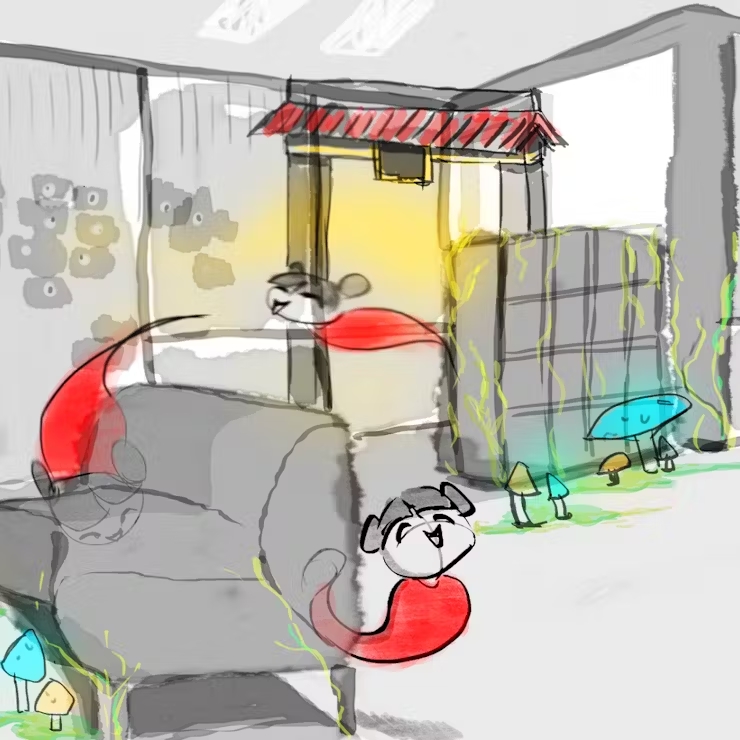
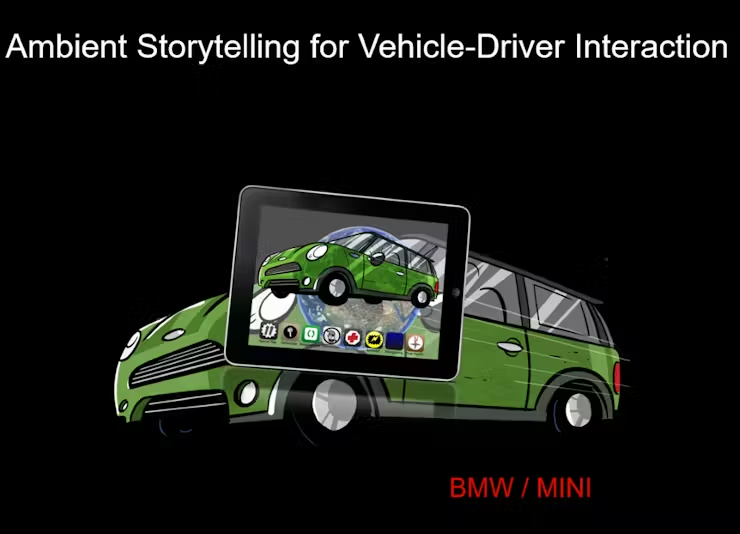
The Mobile and Environmental Media Lab is currently exploring location-specific mobile storytelling. This research investigates the idea of ambient storytelling and how the built environment can act as a storytelling entity that engages and interacts with people in specific spaces. ( read more)
|
|